When hardware-hole processing starts slowing a cabinet or furniture line, buyers often ask which machine is “better.” In practice, the decision is rarely about drilling alone. It is about how much of the work repeats, how often patterns change, and whether the drilling cell is expected to behave like a dedicated production station or a flexible digital process.
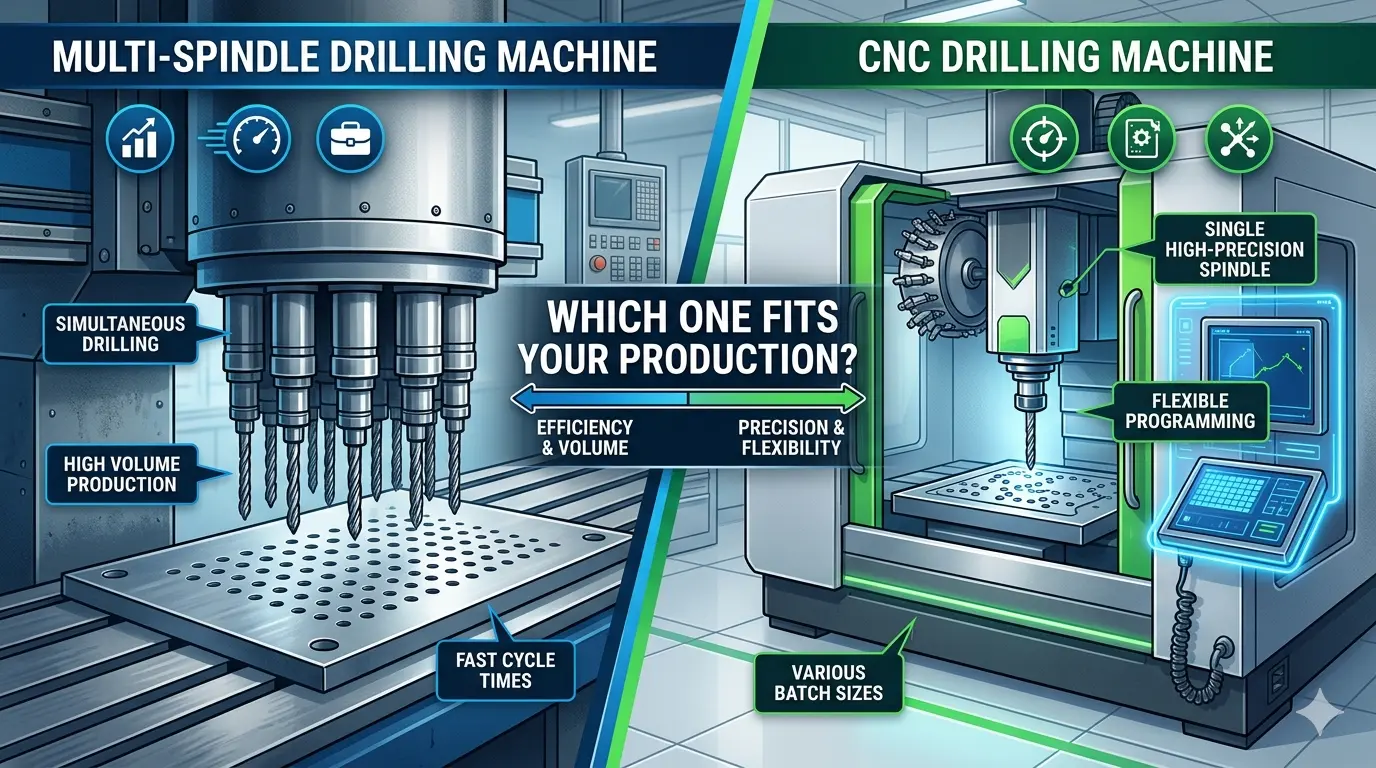
In this article, “multi-spindle drilling machine” refers to a dedicated repeated-pattern format commonly used for line boring and cabinet-part preparation, while “CNC drilling machine” refers to a programmable CNC-controlled drilling solution used when hole locations and part logic change more often. For repeated cabinet drilling, a multi-spindle format often protects better throughput. For variable parts, custom sizing, and frequent model changes, CNC drilling usually protects better flexibility. The right choice depends on what kind of time loss your factory is actually trying to remove.
The Real Comparison Is Stability vs. Flexibility
Many purchases go wrong because the comparison is reduced to machine type alone. On a real shop floor, drilling performance is shaped by more than spindle motion. It depends on how easily the team can keep reference positions consistent, how much changeover is needed between parts, and how reliably drilled components move into assembly.
That usually means the decision should be judged against:
- How Often Hole Patterns Repeat
- How Much Setup Changes From Job To Job
- Whether Parts Follow A Standard Cabinet System Or Mixed Custom Geometry
- How Important First-Part Verification Is To Daily Flow
- How Much Downstream Assembly Depends On Hole Consistency
- Whether Drilling Is A Standalone Station Or Part Of A Broader CNC Workflow
A machine that looks more advanced on paper is not automatically the better production choice. The better choice is the one that removes the largest source of delay from your actual drilling workflow.
Where Multi-Spindle Drilling Machines Usually Win
Multi-spindle drilling machines are commonly selected when a factory runs repeated cabinet parts and wants hole-making to stay fast, stable, and easy to repeat across shifts. For line-boring patterns tied to the 32 mm cabinet system, the main advantage is usually not software sophistication. It is the ability to produce repeated hole groups with low cycle-to-cycle variation.
For factories comparing dedicated boring and drilling machines, this matters because repeated drilling often behaves more like a production routine than a complex programming problem. Once the part reference and drilling pattern are established, the work can move through the station with less disruption from constant edits or reprogramming.
That usually makes a multi-spindle format stronger when the line needs:
- Repeated Shelf-Pin, Connector, And Hinge-Hole Patterns
- Stable Cabinet-Part Families Produced In Batches
- Faster Output On Standardized Work Rather Than Constant Job Changes
- Simple, Repeatable Drilling Logic That Operators Can Hold Consistently
- Reliable Hole Positioning For Smoother Hardware Fit And Assembly
In other words, multi-spindle drilling tends to win when the factory already knows what the pattern is and wants to repeat it cleanly at production pace.
Where CNC Drilling Machines Usually Win
CNC drilling machines make more sense when part programs change frequently and drilling logic is no longer fixed enough to justify a dedicated repeated-pattern setup. Their value is usually not that every hole is drilled faster in absolute terms. The value is that different parts can be prepared with less reliance on physical stop changes, manual repositioning logic, or repeated setup interpretation.
That matters in mixed-production environments where panel sizes vary, hardware layouts shift by order, or engineering changes need to reach the machine without rebuilding the station around a fixed drilling pattern. In those cases, programmable drilling helps the factory protect flexibility without losing reference accuracy every time the job changes.
CNC drilling is commonly the stronger fit when the workflow includes:
- Frequent SKU Changes Or Short Production Runs
- Custom Cabinetry Or Project-Based Part Variation
- Hole Patterns That Change By Product, Material, Or Design Revision
- A Need To Reduce Repeated Manual Setup Between Orders
- Closer Coordination Between Engineering Data And Shop-Floor Execution
If drilling is tied to a larger cut-route-drill sequence rather than a dedicated station, some factories also compare standalone CNC drilling against CNC nesting machines because the real decision may be whether flexibility belongs in a standalone drilling cell or inside a broader panel-processing workflow.
Side-By-Side Decision Table
| Decision Factor | Multi-Spindle Drilling Machine | CNC Drilling Machine | Stronger Fit |
|---|---|---|---|
| Repeated Cabinet Drilling Patterns | Usually stronger because the machine is well suited to stable, repeated hole groups | Can handle the work, but full programmability may add complexity the job does not need | Multi-Spindle |
| Frequent Pattern Changes | Usually weaker because stops, references, or setup logic may need more intervention | Usually stronger because drilling logic can change with the part program | CNC |
| Throughput On Standardized Batch Production | Commonly stronger when part families stay consistent | Strong, but not always the most efficient choice if variation is low | Multi-Spindle |
| Flexibility For Mixed Orders And Custom Sizes | More limited when every part differs | Usually stronger because changeover is driven more by programming than by physical reset | CNC |
| Operator Simplicity On Repetitive Work | Often easier to standardize once the job is established | May require more digital process control, depending on the production model | Multi-Spindle |
| Adaptation To Engineering Revisions | Less convenient when hole logic changes often | Usually stronger when revisions are a normal part of production | CNC |
| Best Overall Fit | Stable, repeated drilling workflows | Variable, digital, and change-heavy drilling workflows | Depends On The Shop |
The key point is that one machine type is not simply faster than the other in every case. One is usually better at protecting repetition. The other is usually better at protecting change.
The Hidden Cost Is Usually Changeover, Not Drilling Time
Buyers often focus on cycle time and miss the real source of lost output. In many factories, the largest loss in drilling capacity does not come from the drilling cycle itself. It comes from what happens between parts or between jobs.
If a shop chooses a multi-spindle machine for highly varied work, time may disappear into repeated stop changes, first-part checks, fixture adjustments, and operator interpretation. The machine may still drill accurately, but the workflow around it becomes harder to stabilize.
If a shop chooses CNC drilling for highly repetitive work, the issue is different. The machine may offer excellent flexibility, but the factory may not actually need that level of change management. In that case, the extra layer of programming, digital setup control, and part-data handling does not always translate into more usable output.
The most common hidden losses are usually:
- Repeated First-Part Verification After Every Changeover
- Inconsistent Part Referencing Before The Drill Cycle Begins
- Too Much Manual Resetting Between Similar Jobs
- Programming Effort That Adds Little Value To Highly Repetitive Work
- Poor Batching Logic That Mixes Stable And Variable Parts In The Same Flow
- Assembly Delays Caused By Hole Variation Or Reference Drift
That is why the better investment is usually the machine that removes your dominant source of setup friction, not the one with the most impressive label.
Which Production Environments Usually Benefit Most From Each Machine
A multi-spindle drilling machine usually makes more sense when:
- Most Daily Output Comes From Repeated Cabinet Or Furniture Parts.
- Shelf-Pin, Connector, And Hardware-Hole Patterns Stay Largely Stable.
- Management Wants A Dedicated Drilling Station With Predictable Rhythm.
- The Factory Values Simple Repeatability More Than High Pattern Variation.
- Downstream Assembly Depends On Consistent Hole Location Across Large Batches.
A CNC drilling machine usually makes more sense when:
- Product Mix Changes Frequently Across Orders Or Customer Projects.
- Hole Layouts Vary Enough That Physical Setup Changes Become A Bottleneck.
- Engineering Revisions Need To Reach Production Quickly.
- The Factory Is Moving Toward A More Digital, Program-Driven Workflow.
- Flexibility Protects Daily Output Better Than A Fixed Repeated-Pattern Setup.
These are not small operational differences. They define whether the drilling cell behaves like a repeatable production fixture or a programmable response tool for changing work.
The Best Choice Depends On What Happens Before And After Drilling
Drilling should not be judged as an isolated process. The machine choice affects how parts arrive from cutting, how they are identified at the station, and how smoothly they move into hardware fitting and assembly. A drilling cell that works well in isolation can still slow the line if it does not match the surrounding workflow.
For example, a factory built around stable panel sizing, repeated cabinet modules, and batch assembly often benefits from the predictability of a dedicated multi-spindle setup. A factory handling mixed orders, custom cabinetry, or frequent design updates may gain more from CNC drilling because it reduces the disruption created by change.
The right question is not, “Which machine is more advanced?” The right question is, “Which machine keeps drilled parts moving through our production system with less waiting, less reinterpretation, and less rework?”
Practical Summary
If your drilling work is repetitive, pattern-stable, and closely tied to standardized cabinet production, a multi-spindle drilling machine often delivers the stronger practical result because it keeps hole-making simple, repeatable, and production-oriented. If your work changes often, hole layouts vary by order, and drilling needs to stay aligned with digital production data, a CNC drilling machine usually delivers the better fit.
The real decision is not between old and new technology. It is between two workflow priorities: repeated output and programmable flexibility. Choose the machine that removes the biggest source of delay from your actual drilling process, and the better answer usually becomes clear.