When a shop needs more cutting capacity, a used sliding table saw can look like the fastest way to save money. The price gap can be hard to ignore, especially when production is already busy and management wants to add capacity without tying up too much capital. But on a sliding table saw, the real value does not come from ownership alone. It comes from predictable carriage movement, stable reference points, repeatable cut quality, and service support when something starts drifting.
That is why the decision is rarely just new versus used. It is really a question of whether the upfront savings are large enough to justify the added uncertainty in service, parts, commissioning time, and day-to-day reliability. In some shops, a used machine is a sensible buy. In others, the lower entry price quickly turns into downtime, operator frustration, and rework.
Why Purchase Price Does Not Decide the Real Cost
With a sliding table saw, the purchase price is only the visible part of the decision. The hidden part is how much risk the shop is taking on after the machine arrives.
That risk usually shows up in areas such as:
- Longer Setup And Verification Before The Saw Is Production-Ready
- More Time Spent Checking Fence Accuracy And Cut Consistency
- Delays While Sourcing Parts Or Finding Qualified Service Support
- Operator Slowdown When Machine Behavior Feels Less Predictable
- Rework When Drift Appears In Parts Bound For Edge Banding, Drilling, Or Assembly
If the saw is the main cutting station, those costs can matter more than the initial discount. A cheaper machine that interrupts production during busy weeks is often more expensive in practice than a higher-priced machine that stays stable and easier to support.
There is also a larger planning question. If the business is rethinking not only the saw purchase but the front-end cutting workflow as a whole, a broader review of the Pandaxis product catalog can help confirm whether the decision is really about a sliding table saw or about a different type of cutting system altogether.
Where a Used Sliding Table Saw Can Deliver Real Value
Used equipment is not automatically a bad decision. In the right environment, it can be a financially disciplined one.
A used sliding table saw often makes the most sense when:
- The Shop Has Strong In-House Maintenance Capability
- The Saw Will Serve As A Secondary Or Backup Cutting Station
- Daily Volume Is Moderate Rather Than Relentless Across Multiple Shifts
- The Buyer Can Inspect The Machine Carefully Before Purchase
- Local Service Access Or Reliable Parts Support Is Already Clear
- Production Can Absorb A Longer Setup And Validation Period
In those conditions, the savings may be real because the shop is equipped to manage the uncertainty. The machine does not have to arrive in near-perfect condition to create value. It only has to match the workload and fit a business that can handle a more hands-on ownership model.
This is especially true for factories that want flexible extra capacity rather than a zero-risk primary machine. If the used saw is not carrying the full burden of the production schedule, service risk becomes easier to tolerate.
Where Service Risk Starts to Dominate the Decision
The economics change when the sliding table saw supports the main flow of work. In that situation, machine condition affects more than the cutting cell.
If the saw feeds visible furniture parts, laminated panels, cabinet components, or mixed daily jobs, unstable performance can create downstream problems quickly. A rough carriage, weak fence repeatability, uncertain alignment, or hard-to-source parts do not just slow the operator. They can also create more fitting corrections, more measuring, and more interruptions before assembly.
Service risk usually becomes more expensive than the discount when:
- The Saw Is The Main Cutting Machine Rather Than A Secondary Asset
- The Shop Has Little Margin For Downtime During Busy Production Weeks
- Operators Need Predictable Results Across Mixed Materials And Frequent Job Changes
- There Is No Nearby Technician Or Clear Parts Path For The Machine
- Cut Quality Drift Would Cause Visible Defects Or Downstream Rework
- The Business Is Trying To Standardize Performance Across Shifts Or Less Experienced Operators
In those cases, management is not really buying a used machine. It is buying a maintenance project with production exposure. Sometimes that is still acceptable. Often it is not.
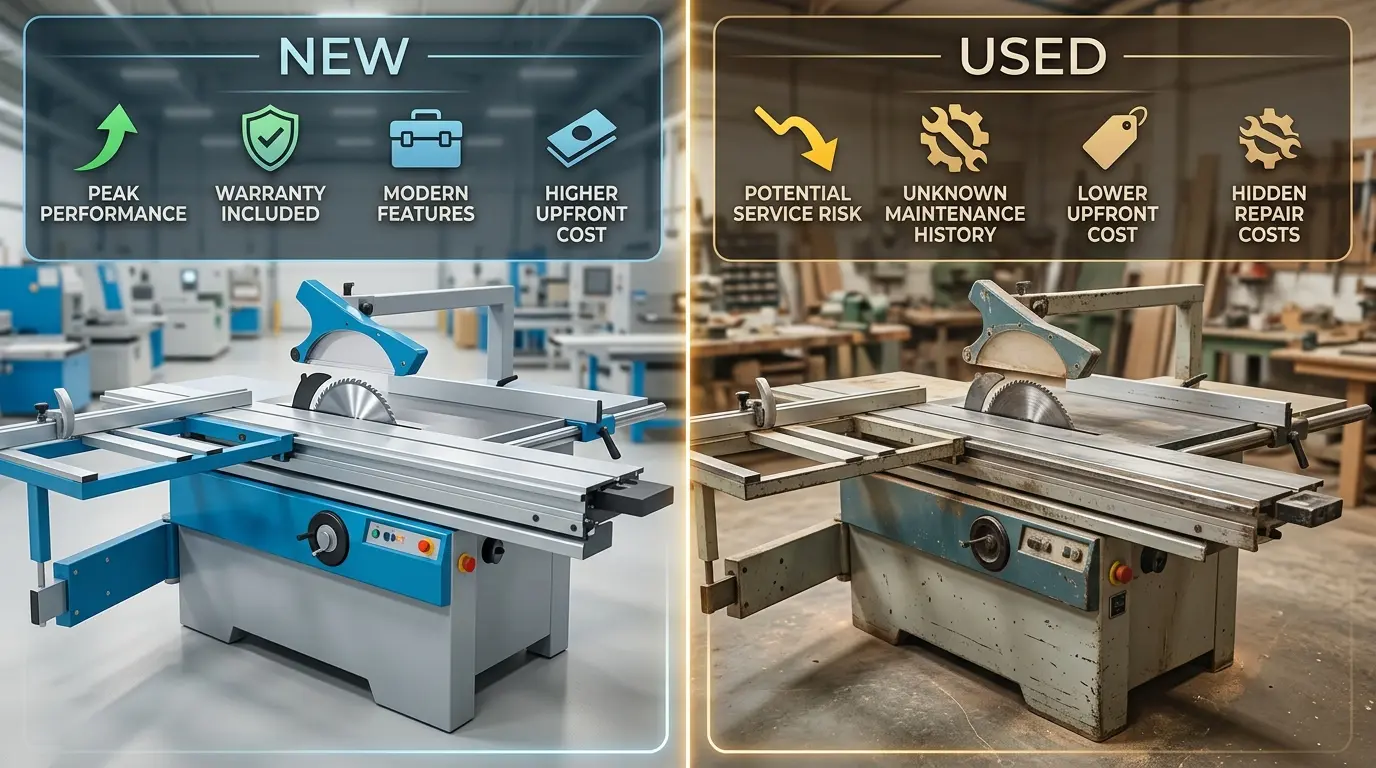
New vs. Used Sliding Table Saw: Side-by-Side Decision Table
| Decision Factor | New Sliding Table Saw | Used Sliding Table Saw |
|---|---|---|
| Upfront Cash Requirement | Higher initial investment | Lower initial purchase cost |
| Commissioning Confidence | Usually easier to put into production with fewer unknowns | Often requires more checking, adjustment, and validation |
| Service Predictability | Better clarity on support path and ownership starting point | More variable depending on condition, age, and service history |
| Parts Availability Confidence | Usually stronger and easier to plan around | Can be uncertain if the machine is older or support is fragmented |
| Operator Trust In Daily Use | Easier to standardize when behavior is stable from the start | Can depend heavily on inspection quality and machine condition |
| Downtime Exposure | Usually lower if the machine is properly matched to the workload | Can be higher if wear or service gaps show up after installation |
| Fit For A Primary Production Saw | Usually stronger | Only strong when condition and support are both well understood |
| Fit For A Secondary Or Backup Saw | Sometimes harder to justify on cost alone | Often more attractive if risk is contained |
| Total Cost Visibility | More predictable over the first ownership period | Can change quickly if alignment, parts, or repairs are needed |
The table makes the tradeoff clear. New equipment asks for more money up front, but it usually buys more certainty. Used equipment lowers the barrier to purchase, but it shifts more responsibility onto inspection, maintenance discipline, and service planning.
What to Verify Before Buying Used
The smartest used-equipment buyers do not focus only on whether the machine still runs. They focus on whether it can hold a stable production routine without constant compensation.
Before buying a used sliding table saw, verify points such as:
- Carriage Travel Quality Across The Full Working Stroke.
- Fence Stability And Confidence That Settings Lock And Repeat Cleanly.
- Proof-Cut Results For Size, Squareness, And Edge Quality On Real Shop Materials.
- Signs Of Impact Damage, Wear, Or Informal Repairs Around Critical Reference Areas.
- Service Records, Ownership History, And Evidence Of Consistent Maintenance.
- Local Access To Service Support And Wear Parts Before The Machine Becomes Urgent.
- Condition Of Safety Devices, Controls, And Related Working Components.
- Whether Any Installed Options, Such As A Scoring Unit If Equipped, Still Support Clean Practical Use.
That inspection process should be tied to your workflow, not just to general machinery appearance. A machine can look acceptable and still create problems if the fence drifts, if carriage movement feels inconsistent under load, or if cut verification takes too much time to trust.
When Buying New Usually Makes More Sense
Buying new is usually the safer decision when the machine has to protect schedule reliability, operator confidence, and repeatable output from day one.
That is commonly true when:
- The Saw Will Anchor The Main Cutting Cell
- Production Is Growing And Downtime Is Becoming More Expensive
- Operators Need Faster Ramp-Up Without Learning Around Machine Wear
- The Business Wants Cleaner Ownership Visibility Over Service And Performance
- Cut Stability Matters To Downstream Edge Quality, Drilling Accuracy, Or Assembly Fit
In those situations, reviewing current sliding table saw options against the actual production mix is usually more practical than chasing the lowest purchase price. The goal is not simply to own a machine. The goal is to install a cutting station that behaves predictably enough to support the rest of the workflow.
New equipment also tends to make more sense when management wants a clearer baseline for maintenance and process control. Starting from a more stable machine condition reduces the number of unknowns that operators and supervisors need to solve at the same time.
When a Used Machine Still Makes Practical Sense
Used can still be the better answer when the risk is deliberate, limited, and manageable.
That is often the case when the shop is buying:
- A Backup Saw For Overflow Or Contingency Use
- A Flexible Secondary Machine For Mixed Or Occasional Jobs
- An Interim Capacity Increase While A Larger Factory Plan Is Still Taking Shape
- A Lower-Capital Asset For A Team That Already Knows How To Service Similar Equipment
In those scenarios, the used-machine discount can remain a real financial advantage because the factory is not expecting the machine to carry the entire production promise by itself. The business is buying capacity with known limits, not pretending it is buying certainty.
Ask These Questions Before You Decide
Before choosing new or used, ask the decision in operational terms:
- Is The Main Goal Lower Capital Spend, Or Lower Production Risk?
- Will This Saw Be A Primary Machine Or A Secondary One?
- Can The Team Diagnose And Resolve Service Issues Without Derailing Production?
- How Expensive Would Two Or Three Unplanned Downtime Events Be During A Busy Month?
- How Sensitive Is The Workflow To Cut Drift, Rechecking, And Rework?
- Are You Buying A Machine, Or Are You Also Buying A Recovery Project?
Those questions usually clarify the right answer faster than comparing price alone. The lower-cost machine is only the better buy if the shop can carry the extra uncertainty without damaging throughput, quality, or schedule reliability.
Practical Summary
The case for a used sliding table saw is simple: lower upfront cost, faster access to capacity, and sometimes a very reasonable return if the shop can manage service exposure well. The case for a new sliding table saw is different: higher entry price, but stronger confidence in commissioning, support, and daily reliability.
If the machine will serve as a secondary saw, if maintenance capability is strong, and if production can absorb some uncertainty, used may be the sensible financial move. If the machine will support the main cutting workflow, if downtime is costly, or if service support is uncertain, the safer decision is often new. The real comparison is not cheap versus expensive. It is savings now versus risk later, and the right answer depends on how much later-stage disruption your factory can afford.