A sheet metal laser cutting machine can post impressive cutting speeds on a sample job and still underperform on the factory floor. In most plants, productivity falls short because setup time, job sequencing, gas stability, first-off approval, consumable condition, and unloading flow are not controlled tightly enough to support steady output.
That is why setup should be treated as a production system rather than a pre-cut checklist. When setup is stable, the cutting cell produces more accepted parts per shift with fewer interruptions, less rework, and less downstream delay. When setup drifts, the machine may still be cutting, but the workflow around it slows down.
Why Productivity Problems Start Before the First Sheet Is Cut
Laser productivity is often framed as a speed question, but many of the biggest losses happen before or between cuts.
- Material Is Not Staged in a Logical Sequence
- Operators Spend Too Long Confirming or Correcting Recipes
- Nozzle or Focus Drift Creates Unstable First-Off Results
- Assist Gas Supply Is Not Matched to the Actual Job Requirement
- Parts Leave the Table Faster Than They Can Be Sorted or Released
These issues do more than increase idle time. They also reduce first-pass acceptance, create unnecessary deburring or cleanup, and make downstream bending, welding, and assembly harder to schedule. In practice, productivity is the combination of cutting time, changeover time, first-pass quality, and how smoothly parts move to the next operation.
The Setup Factors That Usually Decide Output
| Setup Factor | What It Controls | Productivity Impact |
|---|---|---|
| Job Grouping and Material Planning | How often the line changes thickness, grade, or process requirement | Fewer changeovers and faster first-off approval |
| Nozzle, Focus, and Beam Stability | Cut consistency, edge quality, and hole behavior | Less retuning, fewer rejected sheets, and more stable batch output |
| Assist Gas Strategy | Oxidation level, edge condition, and usable cutting speed | Better match between cut quality and downstream needs |
| Pierce and Lead-In Settings | Start quality and feature stability | Less splash-related scrap and fewer detail defects |
| Nesting and Cut Sequence | Heat behavior, part movement, and unload efficiency | More usable parts with less distortion and less handling delay |
| Loading, Support, and Unloading Flow | Machine idle time between sheets and part-release speed | Higher actual throughput across the full shift |
| Parameter Standardization | Repeatability across operators and repeat jobs | Faster setup and lower dependence on trial-and-error tuning |
| Consumable and Maintenance Discipline | Frequency of unexpected process drift or stoppage | More available machine time and more predictable scheduling |
The common pattern is simple: the best-performing plants do not rely on one aggressive recipe to solve every job. They build a setup method that keeps variation inside a controlled operating window.
Material Planning and Job Grouping Set the Ceiling
Many productivity problems begin with job mix rather than machine capability. If the schedule forces constant switching between thicknesses, grades, or edge-quality requirements, the setup team spends too much time verifying conditions that could have been stabilized earlier.
Strong setup discipline usually includes:
- Grouping Similar Materials and Thicknesses Where Production Logic Allows
- Pre-Staging Sheets So the Next Job Is Ready Before the Current Job Finishes
- Confirming Material Condition Before Release to Cutting
- Separating Jobs That Need Different Edge-Quality Standards or Gas Strategies
This matters because a cutting cell that changes conditions too often loses time twice. It loses time during physical changeover, and it loses more time when the first sheet of each new batch needs extra checking or correction.
Nozzle Condition, Focus Stability, and Beam Alignment Matter More Than Headline Speed
Plants often chase productivity by pushing cut speed, but unstable consumables usually destroy that gain. If nozzle condition, centering, focus stability, or upstream optical cleanliness drift, the machine may still run fast while producing edges, holes, or starts that require extra inspection or cleanup.
That kind of drift usually shows up as:
- Less Consistent Hole and Slot Quality
- More Burr or Rougher Edge Condition
- Unstable Pierce Behavior
- Greater Need for Operator Intervention
- Rising Scrap on Parts With Dense Internal Features
The practical takeaway is that stable setup begins with a repeatable physical cutting condition. Shops that inspect nozzles, verify centering, and replace worn consumables before quality collapses usually protect productivity better than shops that keep retuning around worn hardware.
Assist Gas Strategy Changes More Than Edge Quality
Assist gas is often discussed as a cutting parameter, but from a productivity standpoint it is a workflow decision. The right gas strategy influences not only cut speed, but also oxidation, edge cleanup, weld preparation, and finishing effort.
| Gas Choice | Usually Fits Best When | Main Productivity Tradeoff |
|---|---|---|
| Nitrogen | Edge cleanliness and lower oxidation matter for downstream welding, coating, or visible-part quality | Higher operating cost, which must be justified by lower rework and cleanup |
| Oxygen | Some jobs prioritize cutting efficiency over bright-edge finish | Added oxidation can increase downstream prep time |
| Compressed Air | Selected jobs can tolerate a more cost-driven setup strategy | Edge condition and consistency may not match higher-finish requirements |
The important question is not which gas is cheapest by itself. It is which gas produces the lowest total processing cost once deburring, welding preparation, inspection, and batch repeatability are included.
Pierce Strategy and Cut Sequence Often Decide Whether Speed Is Usable
A cutting cell can look productive on straight contours while losing time on starts, small features, and heat-sensitive geometry. That is why setup should include more than basic speed selection. Pierce timing, entry behavior, lead-ins, part spacing, and cut order all influence whether the programmed speed produces usable parts.
Shops usually see better productivity when they:
- Match Pierce Behavior to Material and Thickness Instead of Using a Broad Default Recipe
- Review Small Holes, Narrow Webs, and Dense Feature Areas Separately From Outer Contours
- Sequence Cuts to Limit Heat Buildup in Sensitive Areas of the Nest
- Protect Skeleton Stability So Parts Do Not Shift Late in the Program
This is where setup and nesting become tightly linked. High speed is only valuable when the chosen sequence keeps the sheet stable enough for the last parts to finish in the same condition as the first.
Loading, Unloading, and Part Sorting Are Part of Setup
Many factories talk about setup as if it ends when the operator presses start. In reality, setup also includes how the next sheet arrives, how the current nest is supported, and how finished parts are removed, sorted, and released.
If loading is slow, the machine waits. If unloading is disorganized, cut parts pile up faster than they can move downstream. If part sorting depends too heavily on manual interpretation, the cutting cell becomes a hidden bottleneck for bending or assembly.
Productivity usually improves when the plant looks at these practical questions:
- Is the Next Sheet Ready Before the Current Cycle Ends?
- Can Operators Remove Parts Without Creating Delay or Mix-Up Risk?
- Are Skeleton Removal and Part Separation Planned Into the Job?
- Does the Downstream Team Receive Parts in a Sequence It Can Use?
In other words, a fast cutting machine does not guarantee a fast cutting department. The department becomes productive when setup supports a steady sheet-to-sheet flow and clean handoff to the next process.
Parameter Standardization Reduces Retuning and First-Off Delay
One of the clearest differences between average and high-performing laser operations is recipe discipline. When parameter libraries are weak or poorly maintained, operators spend too much time rebuilding acceptable settings from memory or adjusting them job by job.
That approach can still produce parts, but it does not scale well. It increases operator dependence, makes results inconsistent across shifts, and lengthens first-off approval.
More productive plants usually build setup discipline around:
- Controlled Parameter Libraries for Common Material and Thickness Combinations
- Clear Rules for When a Recipe Can Be Reused and When It Must Be Reviewed
- First-Article Checks Focused on Critical Dimensions and Edge Condition
- Feedback From Bending, Welding, and Assembly to Refine Setup Standards
This kind of standardization does not remove engineering judgment. It reduces avoidable variation so engineering time is spent on real process improvement rather than repeating yesterday’s troubleshooting.
What Production Managers Should Measure
If productivity is the goal, managers need to look beyond advertised machine speed and track the indicators that expose setup losses.
| Metric | What It Reveals |
|---|---|
| Average Sheet-to-Sheet Changeover Time | Whether material staging and setup readiness are under control |
| First-Pass Acceptance at the Cutting Cell | Whether recipes, consumables, and setup verification are stable |
| Deburring or Cleanup Time per Batch | Whether the chosen setup is pushing hidden cost downstream |
| Unplanned Stops Caused by Consumables, Gas, or Alarms | Whether setup stability is being protected well enough |
| Time From Cut Completion to Release for the Next Process | Whether unloading and part sorting are limiting real throughput |
| Repeatability Across the First, Middle, and Last Sheets of a Batch | Whether heat, support, and cut sequence are staying inside a stable window |
These measurements make setup visible. Without them, it is easy to assume the machine is productive because it spends a high percentage of time cutting, even when the total batch flow says otherwise.
Practical Summary
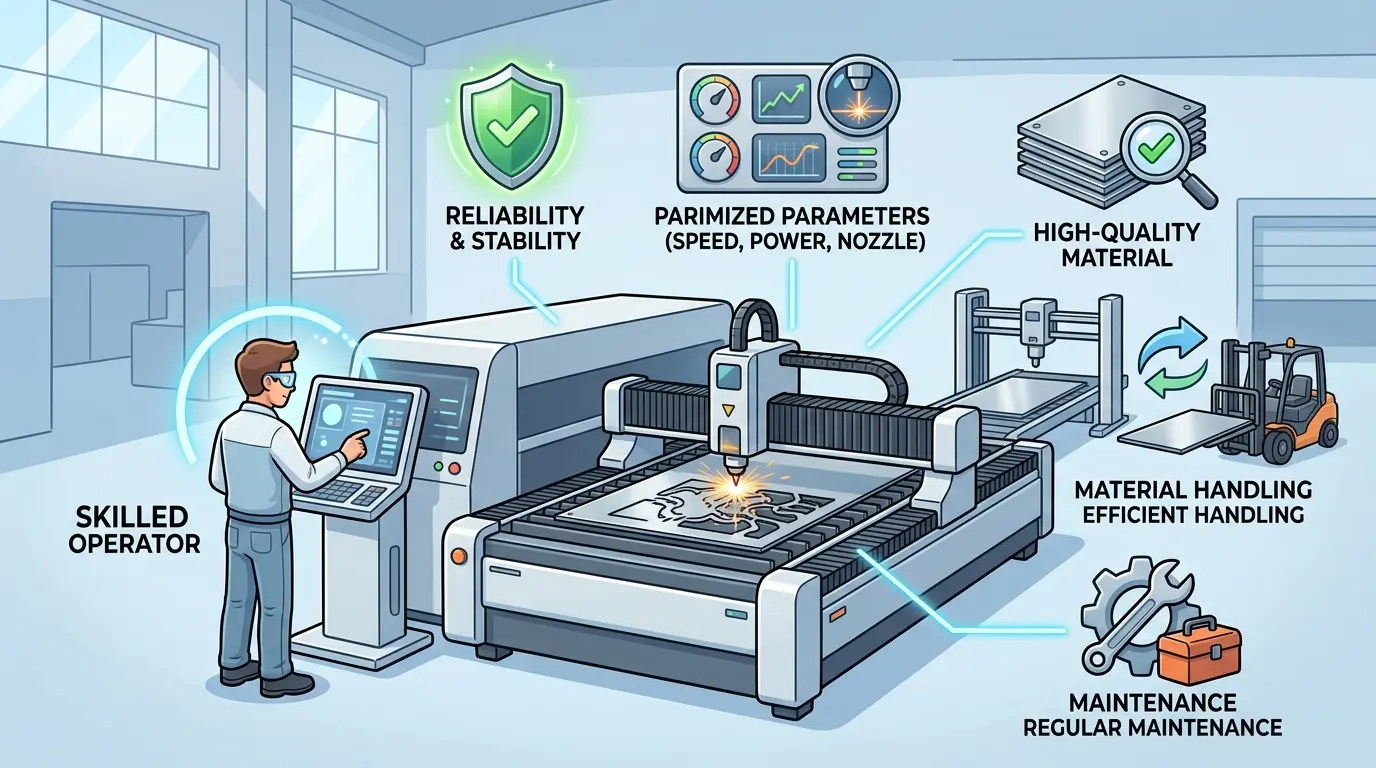
Sheet metal laser cutting productivity is shaped less by peak cutting speed than by setup stability. Material planning, nozzle and focus condition, assist gas selection, pierce control, nest sequence, loading flow, unloading discipline, and parameter standardization all influence how many usable parts the cell can release per shift.
The most productive setups are the ones that protect the entire workflow. They reduce first-off delay, lower rework, keep downstream operations supplied with stable parts, and turn machine time into completed production rather than isolated cutting output.
If the discussion is broader than one cutting cell and includes adjacent production equipment decisions, the Pandaxis product catalog can serve as a broader reference point for factory equipment planning.