When a shop compares a sliding table saw with a vertical panel saw, the real question is usually not which one can cut a board. The real question is what the cutting area needs to solve every day: limited floor space, changing job requirements, awkward full-sheet handling, or recurring fit problems at assembly.
That is why this comparison matters. A vertical panel saw can make sheet breakdown more manageable in a tighter footprint. A sliding table saw can keep one cutting station useful across a broader range of work. Both can support accurate cutting when they are properly set up, but they protect accuracy in different ways and under different shop conditions.
Start With The Workflow Constraint, Not The Saw Category
Before comparing machines, identify the friction that is slowing production down now.
- Is The Cutting Cell Taking Too Much Horizontal Floor Space?
- Are Full Sheets Difficult To Stage, Load, And Control Safely?
- Does One Saw Need To Handle Sheet Goods, Solid Wood, And Frequent Job Changes?
- Are Straight Panel Cuts Repetitive Enough That A More Structured Breakdown Process Would Help?
- Is Cut Accuracy Drifting Because Operators Are Constantly Switching Between Very Different Tasks?
These questions usually lead to a better decision than a feature-by-feature comparison. In practice, the better machine is the one that removes the most costly source of delay, rehandling, or rework from the cutting stage.
How The Space Requirement Changes In Real Shops
The biggest difference appears before the first cut is made. It shows up in how the saw occupies the layout and how material moves around it.
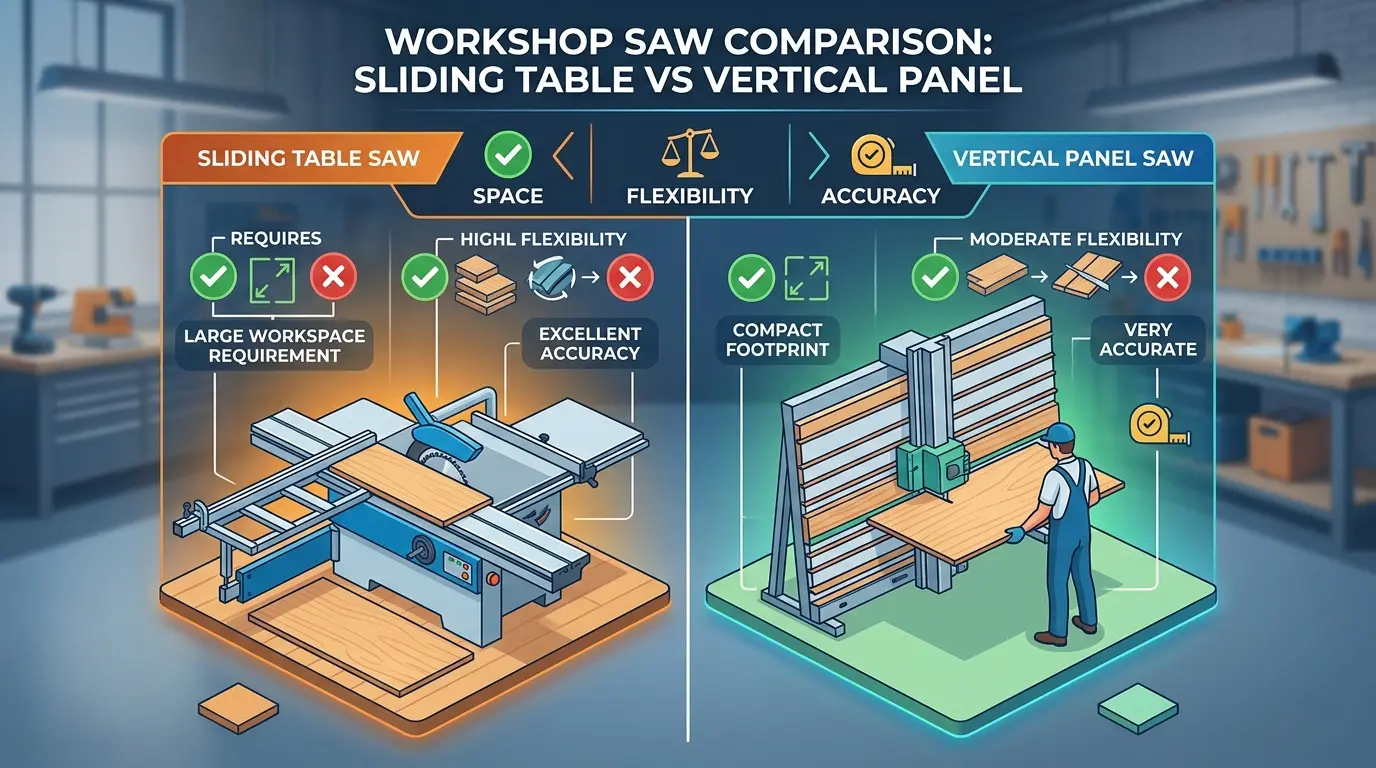
A vertical panel saw is commonly chosen because it uses upright working space instead of demanding a long horizontal cutting zone. That can be valuable in workshops where wall space is available but aisle width and open floor area are limited. For shops breaking down MDF, plywood, particle board, melamine-faced board, and similar sheet materials, the upright format can make the cutting area easier to fit into the overall layout.
A sliding table saw usually needs a broader horizontal working envelope. The carriage travel, infeed, outfeed, and operator movement all require clear space. That larger footprint is not automatically a disadvantage. In many shops, the extra room is worthwhile because the machine covers more than simple sheet breakdown.
| Layout Factor | Vertical Panel Saw | Sliding Table Saw | What It Means In Practice |
|---|---|---|---|
| Floor Footprint | Uses upright space more efficiently | Needs a larger horizontal cutting zone | Vertical formats often fit better where floor space is under pressure |
| Full-Sheet Handling | Keeps sheets in an upright working position | Requires horizontal support and travel across the table | Vertical handling can be easier to organize in tighter layouts |
| Aisle Impact | Often easier to place along a wall | Demands more clearance around the machine | Sliding layouts need more dedicated cutting-cell space |
| Material Staging | Better when sheet storage and breakdown stay close together | Better when the shop can support wider infeed and outfeed movement | Layout planning matters as much as the machine itself |
| Expansion Effect | Helps compact sheet processing without building a larger cell | Gives the saw more room to cover mixed cutting tasks | The right answer depends on whether space or versatility is the bigger constraint |
The practical takeaway is simple: a vertical panel saw usually helps when the shop is trying to preserve floor area. A sliding table saw usually makes more sense when the layout can support a wider cutting station and the machine is expected to do more varied work.
Flexibility Is Usually The Deciding Difference
This is where the two saw types separate more clearly.
A vertical panel saw is usually strongest when the work is centered on straight sheet breakdown. If the goal is to convert full panels into manageable parts in a compact area, it can be a very practical solution. That is especially true when the cut pattern is fairly orderly and the shop wants the front end of production to feel more controlled.
A sliding table saw is usually stronger when the daily workload changes often. It is commonly a better fit when one machine needs to cut sheet goods, trim solid wood parts, handle varied dimensions, and support short runs or project-based work without forcing the operator into a narrow production routine.
| Work Pattern | Vertical Panel Saw Usually Fits Better When… | Sliding Table Saw Usually Fits Better When… |
|---|---|---|
| Straight Sheet Breakdown | The day is heavily centered on repeated panel cutting | The sheet work is only part of a more varied cutting schedule |
| Job Changes | The cut sequence stays relatively structured | The work changes frequently between parts, materials, or dimensions |
| Mixed Material Work | Sheet goods dominate the cutting load | Panels and solid wood parts both matter in the same shift |
| Custom Work | Variation is limited and mostly rectangular | Project-specific adjustments are routine |
| One-Machine Coverage | The saw mainly serves as a sheet-breakdown station | The saw must remain a general-purpose cutting tool |
This is why shops focused on custom furniture, interior fit-out work, and varied panel-plus-solid-wood production often lean toward a sliding table saw. The machine protects flexibility. Shops that mainly need to break down sheet material in limited space often find the vertical format more practical.
Cut Accuracy Depends On Where Consistency Is Easier To Hold
Both machines can produce accurate cuts when they are matched to the job and maintained properly. The better comparison is not theoretical precision. It is where accuracy becomes easier to repeat under normal shop conditions.
With a vertical panel saw, accuracy often benefits from a more controlled approach to sheet breakdown. When the work is mainly straight panel processing, the machine can make large sheets easier to position in a stable, repeatable way without asking the operator to manage a wide horizontal table every time. That can reduce handling-related inconsistency, especially in smaller shops where space pressure makes full-sheet movement awkward.
With a sliding table saw, accuracy can be excellent, but it usually depends more directly on setup discipline, fence consistency, carriage condition, blade selection, and operator method. That is not a weakness when the shop needs versatility. It simply means the saw protects accuracy best when the operator has the space and workflow support to set up each job cleanly.
| Accuracy Factor | Vertical Panel Saw | Sliding Table Saw | Why It Matters |
|---|---|---|---|
| Full-Sheet Control | Often easier to manage in tight layouts | Strong when the shop has enough room to support the full panel cleanly | Sheet handling affects cut consistency before the blade enters the material |
| Repeatability On Straight Cuts | Commonly strong for structured panel breakdown | Commonly strong when setup is carefully maintained | Repetition rewards stability, but both machines can achieve it |
| Adaptability Without Losing Accuracy | Less flexible when cuts become more varied | Better suited to changing dimensions and task types | Accuracy under variation is different from accuracy in one repeated task |
| Operator Dependence | Usually lower for basic repetitive panel breakdown | Usually higher because more tasks rely on operator-guided setup | The burden of consistency sits in different parts of the workflow |
| Downstream Fit Risk | Helps when the problem starts with awkward sheet breakdown | Helps when the problem starts with varied cuts and changing setups | Rework often comes from the workflow, not the machine label |
If a shop mainly cuts full sheets into rectangular parts, a vertical panel saw can make accuracy easier to hold because the handling routine becomes more orderly. If the shop moves constantly between panels, trim parts, short runs, and changing dimensions, a sliding table saw often protects real-world accuracy better because it is built around broader task flexibility.
Which Shop Conditions Usually Favor Each Option
The right answer becomes clearer when the decision is tied directly to shop conditions.
Choose a vertical panel saw first when:
- Floor Space Is Tight But Full Sheets Still Need To Be Processed Regularly.
- The Cutting Work Is Mostly Straight Sheet Breakdown.
- The Shop Wants A Cleaner Front-End Process Without Building A Larger Horizontal Cell.
- Layout Pressure Is Creating Material Handling Problems Around The Cutting Area.
- The business benefits more from compact organization than from broad cutting versatility.
Choose a sliding table saw first when:
- One Saw Must Cover A Wider Mix Of Work.
- Panels And Solid Wood Parts Both Matter In Daily Production.
- Operators Need Direct Control Over Varied Cuts, Short Runs, And Frequent Adjustments.
- The shop values flexibility more than a narrower sheet-breakdown routine.
- Accuracy problems are tied more to changing setups than to cramped sheet handling.
For shops evaluating broader operator-guided cutting platforms, sliding table saws usually remain the more adaptable category. If repeated rectangular panel output continues to grow, the next comparison often shifts toward a more dedicated panel saw workflow rather than staying within a two-machine comparison forever.
When Neither Saw Should Be The Final Answer
Some shops force this decision for too long.
If panel volume keeps rising, cut lists become more standardized, and the front end of production starts demanding stronger throughput and process discipline, the long-term answer may not be either a sliding table saw or a vertical panel saw. At that point, the real issue may be that the shop has outgrown a manually centered cutting strategy.
Likewise, if the business needs cutting, routing, and drilling to work together more closely, the next step may be a different process entirely rather than a smaller debate between two saw formats.
That matters because good buying decisions should match both the current bottleneck and the likely growth path. A machine that solves today’s space issue but conflicts with tomorrow’s production structure can still become an expensive compromise.
A Simple Decision Filter
| If The Real Problem Is… | The Better First Direction Is Usually… |
|---|---|
| The Cutting Area Is Too Large For The Available Layout | Vertical Panel Saw |
| One Saw Must Cover Mixed, Changing Work | Sliding Table Saw |
| Full-Sheet Breakdown Is Awkward In A Tight Shop | Vertical Panel Saw |
| Accuracy Must Be Protected Across Many Different Job Types | Sliding Table Saw |
| Repeated Panel Output Is Growing Beyond A Manual Cutting Rhythm | Reevaluate Against A Dedicated Panel-Saw Workflow |
This kind of filter is usually more useful than asking which saw is better in the abstract. One machine protects space and structured panel breakdown better. The other protects flexibility and wider task coverage better.
Practical Summary
A vertical panel saw usually makes more sense when the shop needs compact sheet processing, better use of limited floor space, and a more manageable approach to straight panel breakdown. A sliding table saw usually makes more sense when the cutting station still has to absorb varied work, changing dimensions, and a broader mix of materials without sacrificing operator control.
In terms of cut accuracy, neither machine wins universally. The better choice is the one that makes consistency easier to repeat in your actual workflow. If cramped layout and full-sheet handling are undermining cut quality, the vertical format may be the smarter answer. If varied tasks and constant setup changes are the real source of inconsistency, a sliding table saw is usually the better fit.