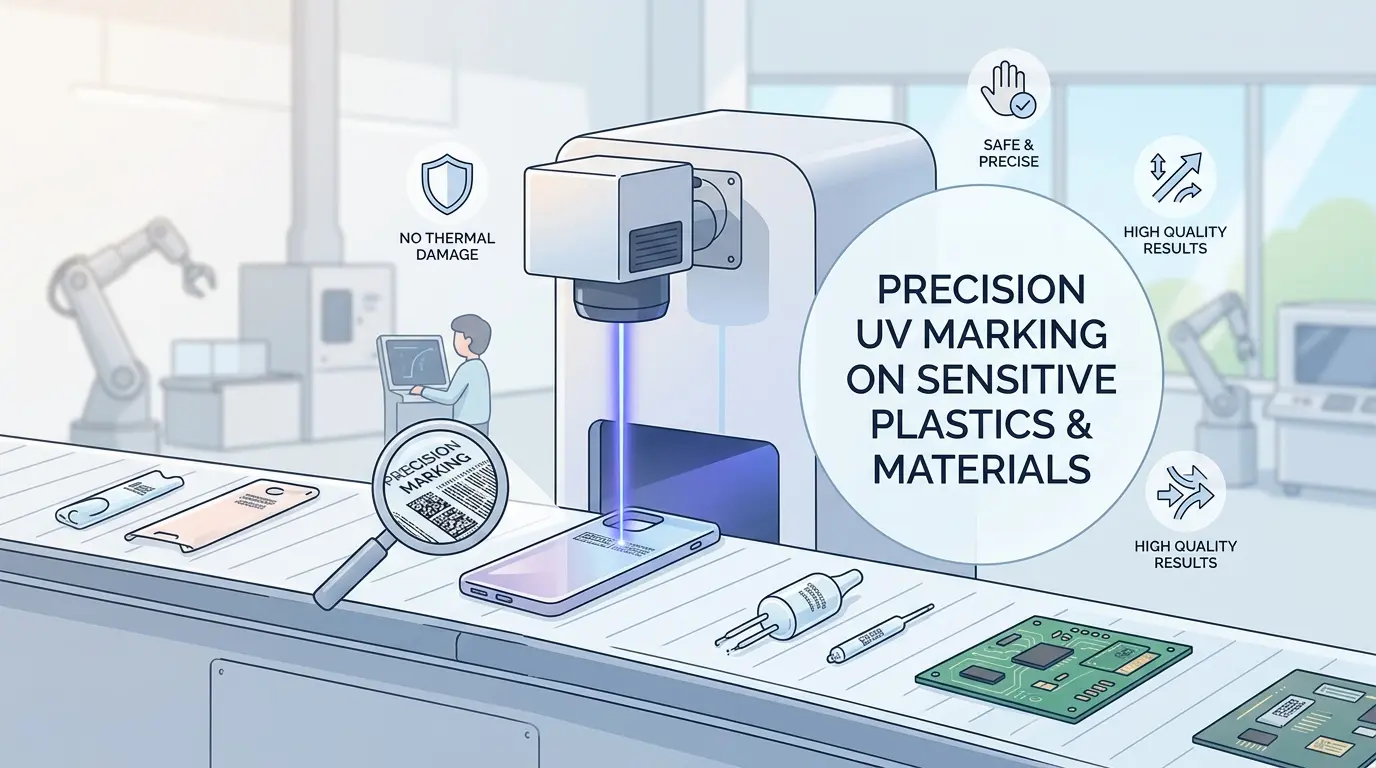
When a production line needs permanent marks on thin plastics, coated housings, labels, or other appearance-sensitive parts, the real problem is rarely whether a mark can be made at all. The harder question is whether the mark can stay sharp and readable without whitening the surface, distorting a thin wall, creating a visible halo, or pushing reject rates up on parts that already carry tight cosmetic standards. That is why a UV laser marking machine is usually evaluated as a quality-control tool before it is treated as a general-purpose laser purchase.
For fine plastics and other sensitive substrates, the buying logic shifts away from broad “can it process this material” thinking and toward process stability, cosmetic control, and repeatable code quality. A machine that makes a visible mark is not automatically the right machine if the surrounding material suffers every time the job runs.
Why Fine Plastics Change the Selection Logic
Fine plastic parts tend to expose weaknesses in thermal marking processes quickly. A surface that looks acceptable on a thicker, more forgiving substrate may show whitening, edge spread, gloss change, or slight deformation once the wall section becomes thinner or the finish becomes more cosmetic.
That is why buyers often start looking at UV marking when they are dealing with problems such as:
- Small Text Or Compact Codes On Thin Plastic Components
- Branding On Coated Or Appearance-Sensitive Surfaces
- Marking Near Fine Features, Ribs, Clips, Or Thin Edges
- Delicate Labels, Films, Or Laminated Layers That Cannot Tolerate Excess Heat
- Traceability Work Where a Clean, Dense Code Matters More Than Deep Material Removal
In these situations, the goal is not aggressive engraving. The goal is controlled marking with less collateral damage around the mark field.
What Buyers Are Really Paying For in a UV Marking Workflow
Many purchasing conversations reduce the machine decision to source type alone. In practice, buyers are not paying for a label such as “UV.” They are paying for a better chance of holding mark quality on substrates that are easy to damage.
In production terms, a UV laser marking machine is commonly considered when the line needs:
- Better Edge Definition On Fine Characters And Dense Codes
- Lower Risk Of Visible Melt Or Surface Distortion
- More Controlled Results On Coated, Painted, Or Decorated Surfaces
- Cleaner Cosmetic Output On Premium Or Consumer-Facing Parts
- Reduced Rework From Marks That Are Technically Visible But Visually Unacceptable
This distinction matters because many jobs described as “engraving” are, in reality, surface marking jobs with a high cosmetic penalty for excess heat. If the line does not need deep removal, broad fill engraving, or contour cutting, then part quality often becomes the first selection filter.
Which Sensitive Materials Usually Trigger UV Evaluation
“Sensitive materials” is a broad term, and buyers should be careful with it. In real factories, sensitivity usually comes from one of four conditions: the substrate is thin, the finish is cosmetic, the surface stack is layered, or the material reacts inconsistently to heat.
Common evaluation cases include:
- Fine Plastic Housings And Covers
- Coated Or Painted Plastic Parts
- Films, Labels, And Flexible Layers
- Clear Or Decorative Plastics Where Surface Whitening Is Unacceptable
- Appearance-Sensitive Consumer Components
- Certain Glass, Ceramic, Or Brittle Decorative Surfaces That Need Fine Surface Marking
The important point is that material family names alone are not enough. Two plastics that look similar in a purchasing brief may behave very differently once colorants, fillers, coatings, additives, or surface textures change. That is why sampling and recipe separation matter more here than in more forgiving marking jobs.
Where UV Laser Marking Usually Fits Best
| Production Scenario | Why UV Is Commonly Evaluated | Workflow Benefit | Main Watchpoint |
|---|---|---|---|
| Thin Plastic Parts | Lower thermal disturbance is often important on fine walls and delicate geometry | Better cosmetic control and fewer heat-related rejects | Exact polymer behavior can vary by grade and finish |
| Coated Or Painted Surfaces | Buyers often need a mark that stays controlled without rough surrounding damage | Cleaner branding or traceability on finished parts | Coating chemistry can change contrast and repeatability |
| Dense Codes And Small Characters | Fine mark control matters more than heavy removal | Better chance of readable compact codes in limited space | Visual sharpness does not always guarantee scanner performance |
| Labels, Films, Or Laminated Materials | Heat sensitivity can be high even when the mark area is small | Reduced risk of damaging adjacent layers or light substrates | Handling, fixturing, and tension control still matter |
| Premium Appearance Parts | Cosmetic standards often carry more cost than simple legibility | Less manual sorting, polishing, or rework after marking | Surface variation between batches can still shift results |
The strongest use cases share the same pattern: the mark is fine, the substrate is easy to disturb, and the cost of visible damage is higher than the cost of using a more controlled process.
Why Material Validation Matters More Than Marketing Language
One of the biggest buying mistakes is to assume that a good sample on one plastic proves stable production behavior across all plastics in the plant. It does not. Color, additives, resin family, coating layer, surface gloss, and even supplier batch variation can all change contrast, edge quality, and cosmetic response.
Before treating UV as the answer, buyers should clarify:
- Which Material Families Will Use the Most Machine Hours
- Whether the Mark Is Cosmetic, Functional, Or Both
- How Small the Character Set Or Code Actually Needs To Be
- Whether the Surface Is Matte, Glossy, Textured, Coated, Or Decorated
- Whether Parts Are Marked Before Or After Finishing Operations
- How Much Variation the Customer Will Accept Between Lots
This is where good purchasing decisions are usually made. The machine has to fit the real substrate mix, not the simplified material names used in a budget discussion.
UV Marking Versus Other Common Marking Approaches
The practical comparison is not always UV versus another laser source alone. Sometimes the real decision is UV versus a broader thermal process, mechanical engraving, or an ink-based identification method.
| Decision Factor | UV Laser Marking | Broader Thermal Or Mechanical Alternatives | What Usually Decides |
|---|---|---|---|
| Fine Cosmetic Marking On Sensitive Plastics | Often Strong Fit | Application Dependent | Heat control and surface appearance matter most |
| Deep Material Removal | Limited Fit | Often Better Elsewhere | Depth and removal speed matter more than delicate surface control |
| Dense Codes In Tight Mark Areas | Often Strong Fit | Application Dependent | Edge definition and compact readability drive the choice |
| Large Filled Areas | Often Less Efficient | Often Better Elsewhere | Throughput and removal volume become the main concern |
| Marking On Finished Consumer-Facing Parts | Often Strong Fit | Application Dependent | Reject cost from visible damage usually dominates |
Buyers who are also reviewing broader non-metal processing equipment can separate marking-specific needs from cutting or engraving requirements by looking at the broader Pandaxis product catalog first, then narrowing the equipment discussion around the actual workflow bottleneck instead of treating every laser purchase as the same category decision.
Low Heat Does Not Remove the Need for Process Discipline
A UV workflow can reduce certain thermal risks, but it does not remove process risk. Repeatable marking still depends on how the production cell is managed day to day.
The factors that usually matter most are:
- Stable Part Positioning
- Clean Surfaces Before Marking
- Consistent Focus Conditions
- Separate Recipes By Material And Finish
- Verification of Scanner Readability, Not Just Visual Appearance
- Good Fume Extraction And Housekeeping
- Clear Controls For Mixed-Product Production
This is especially important in high-mix environments. A line that runs coated housings in one shift and thin uncoated plastic parts in the next will not stay stable if operators treat both as interchangeable jobs. A lower-heat process helps, but material-specific process control is still what protects repeatability.
Throughput Should Be Measured Against Reject Cost
UV marking is often selected because it protects part quality, not because it wins every speed comparison on paper. That changes the ROI discussion. If a buyer compares machines only by raw cycle time, the real value of the UV process can be missed.
In many fine-plastic and sensitive-surface applications, the payoff comes from:
- Fewer Cosmetic Rejects
- Better Code Quality On Small Marking Fields
- Less Manual Rework Or Secondary Cleanup
- More Stable Output Across Appearance-Sensitive SKUs
- Reduced Risk When Marking Finished Parts Late In the Process
If a line loses money mainly through visible heat damage, poor small-code definition, or inconsistent appearance, UV can make economic sense even if another process looks more aggressive in a narrow speed comparison. If the real job is deeper engraving, larger-area removal, or cutting, the economics may point in a different direction.
Questions Buyers Should Resolve Before Comparing Suppliers
Before requesting samples or comparing quotes, buyers should answer a few operational questions clearly:
- Is the Main Goal Cosmetic Branding, Functional Traceability, Or Both?
- Which Specific Plastic Families Cause the Most Heat-Related Problems Today?
- How Small Do the Codes, Characters, Or Logos Need To Be?
- Will Parts Be Marked Before Or After Painting, Coating, Assembly, Or Final Cleaning?
- How Much Cosmetic Variation Will Customers Accept?
- Is the Current Pain Point Reject Rate, Mark Quality, Or Line Stability?
- Does the Plant Need a Dedicated Fine-Marking Solution Or a Broader Process Platform?
These questions usually reveal whether UV is being evaluated for the right reason. If the root problem is delicate material response, appearance control, and fine-detail consistency, the case becomes much stronger. If the real bottleneck is broader material removal or contour processing, a different machine path may make more sense.
Practical Summary
A UV laser marking machine usually makes the most sense when the production risk comes from the substrate, not from the difficulty of making a visible mark. Fine plastics, coated parts, labels, films, and other sensitive materials often push buyers toward UV because the process is commonly evaluated for better cosmetic control, tighter code definition, and lower heat-related reject risk.
The key tradeoff is that UV should not be treated as a universal answer for every marking, engraving, or cutting task. It tends to fit best where fine marks, appearance-sensitive surfaces, and low thermal impact matter more than deep removal or broad cutting capacity. The best buying decision comes from matching the machine to the real material mix, the mark-quality requirement, and the actual cost of rework when sensitive parts go wrong.