
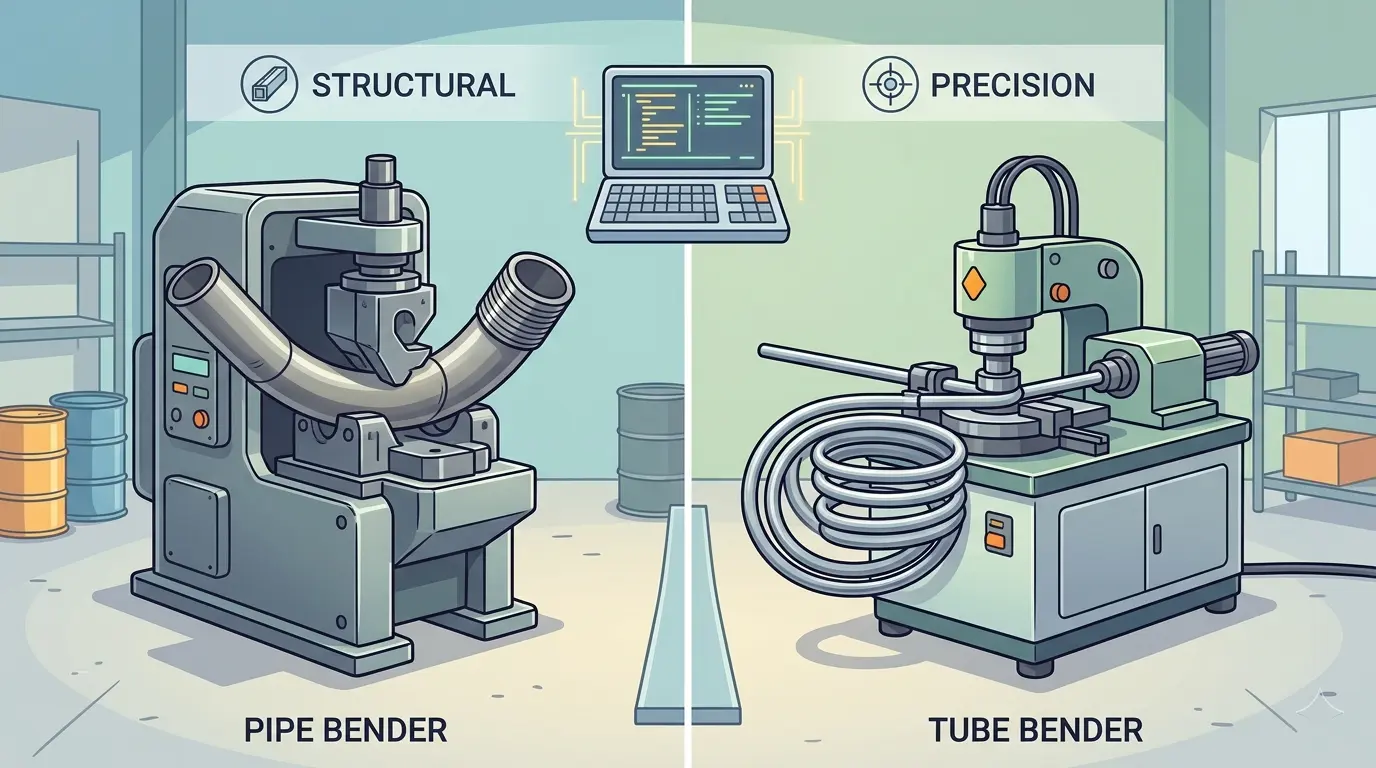
The most expensive mistake in bending-machine buying is assuming that pipe bending and tube bending are basically the same production problem with different labels. They overlap, but they are not interchangeable in the way many sales conversations imply. Once standards, bend sequence, tooling behavior, part support, assembly fit, and visual expectations enter the discussion, the buying logic starts to split.
That matters because shops do not buy bending equipment to satisfy a category word. They buy it to reduce labor, stabilize geometry, protect downstream fit-up, and avoid wasting time in setup and rework. If the machine is chosen from loose vocabulary rather than from the actual part family that must run through it, the purchase often looks acceptable during quoting and awkward during real production.
So the most useful comparison is not “Which label sounds right?” It is “What kind of bending problem does this shop really have, and what machine logic fits that problem best?” Once the decision is framed that way, the difference between pipe-oriented and tube-oriented buying becomes much clearer.
The Terms Overlap In Conversation, But Not In Buying Logic
In casual shop talk, pipe and tube are often used loosely. In procurement and production, that shortcut creates risk. Pipe discussions often start from service, routing, and compatibility questions. Tube discussions more often start from outside dimensions, wall thickness, bend location, visible quality, and how the part fits inside a fabricated assembly.
That does not mean the two worlds have zero overlap. It means buyers and suppliers often carry different assumptions inside the words. If a buyer says “pipe bender” but the profitable workload is actually dimensional tubing for frames, supports, railings, or welded products, the supplier may over-emphasize the wrong strengths. If the buyer says “tube bender” but the real work is service-style pipe with longer sections and heavier handling demands, the evaluation can drift toward the wrong priorities in the other direction.
The safe habit is to define the workload physically and commercially first, and use the vocabulary second.
Pipe Specifications And Tube Specifications Pull The Conversation In Different Directions
One reason the distinction matters is that pipe and tube are commonly bought, described, and inspected through different habits. Pipe work is often discussed around nominal size, schedule, routing, and service expectations. Tube work is more often described through outside dimensions, wall thickness, appearance, and assembly accuracy.
That changes the machine conversation. Pipe-heavy jobs may care more about predictable bend behavior, support for longer or heavier workpieces, and dependable fit-up into installed systems or fabricated lines. Tube-heavy jobs often care more about repeatability from bend to bend, rotation accuracy, and whether the finished part lands reliably in a fixture, weldment, or visible product assembly.
If the RFQ never makes that distinction explicit, the supplier has to guess which production burden matters most. That is where wrong-fit proposals often begin.
The Machine Choice Usually Follows The Part Family, Not The Label
Buyers often ask whether they need a CNC pipe bender or a CNC tube bender. The better question is which part family pays for the machine most often. That sounds like a subtle change, but it shifts the decision from terminology into plant economics.
If the highest-value work is routing-heavy, service-defined, or dependent on robust support and stable bend integrity on larger sections, the evaluation naturally leans one way. If the highest-value work is dimensional tubing used in repeat assemblies where multiple bends, multiple planes, and fixture fit dominate the quality discussion, the evaluation leans another way.
This is why rare edge cases should not control the purchase. The machine should be optimized for the recurring part family first. Buying for the biggest or most difficult part the shop has ever seen can create an expensive mismatch if that part almost never appears.
Pipe Jobs Usually Penalize Weak Support And Inconsistent Radius Control
In many pipe-oriented environments, the expensive failures are fit-up and routing failures. The part has to route correctly, maintain acceptable wall behavior, and arrive at the next step without demanding heroic correction. That pushes the buyer toward questions of support, handling, tooling robustness, and how reliably the system repeats the bend patterns the shop runs most often.
This does not mean every pipe job is heavy or crude. It means the buying logic usually begins with service realism rather than appearance alone. If the work includes longer sections or parts that become expensive once installation starts, then support and repeatability become more important than polished demo language.
That is why pipe-focused buyers often judge a machine less by whether it can produce a good sample bend once and more by whether it can behave credibly on the shop’s actual routing work over time.
Tube Jobs Usually Penalize Twist, Rotation Error, And Assembly Drift
Tube-oriented work often reveals its true cost in fixtures and assemblies. The part can look acceptable when it leaves the bender and still create trouble later if bend position, rotation, or multi-plane sequencing drift from expectation. The operator at the weld fixture then starts forcing the part into place, and the plant ends up paying for bending errors under an assembly labor code instead of a bending code.
That is why tube-focused buying usually emphasizes repeatability across multiple bends, cleaner changeovers, better control of twist, and a system that can hold stable geometry part after part. Visible finish may matter more too, especially when the tube remains exposed in the final product. But the deeper issue is assembly predictability, not showroom beauty.
When a shop says it needs better tube bending, it often really means it needs less downstream correction.
Tooling Changeover And Support Length Often Decide Daily Economics
Many disappointing bending investments come from over-focusing on headline capacity and under-focusing on daily operating economics. Tooling changes, part support, and handling logic decide whether the machine feels flexible or burdensome when the job mix gets real.
If the shop runs many sizes, wall combinations, and bend families, slow tooling changes can erase the value of a technically capable machine. If longer workpieces are common, weak support planning can create repeatability drift that operators compensate for inconsistently. The equipment may still be “capable” on paper and frustrating in practice.
That is why buyers should ask not only what size range the machine covers, but how efficiently it covers the parts that actually generate revenue. A broad envelope is not automatically profitable if the common job families require too much compromise or too much operator improvisation.
High-Mix Shops Should Buy Differently From Dedicated Production Cells
High-mix job shops and dedicated product manufacturers should not buy with the same logic. A high-mix environment often needs fast transition, workable program management, and lower setup pain across varied jobs. A dedicated production cell often needs stable repeat behavior, predictable maintenance rhythm, and lower labor per recurring part.
That means the same bending system can look ideal in one plant and awkward in another. A machine optimized around stable, repetitive work may not help a shop that changes profiles constantly. A very flexible system may be unnecessary capital if most bending hours come from a narrow family of repeat assemblies.
So the right question is not just what the machine can bend. It is how often the plant changes what it asks the machine to bend.
RFQs Need Sample Part Families, Not Just A Process Name
If buyers want strong quotations, they need to provide more than a generic statement that the factory bends pipe or tube. Good RFQs show the representative workload and the operating reality around it.
Useful RFQ inputs usually include:
- Material family.
- Size range and wall-thickness range.
- Typical bend radii.
- Part length range.
- Bends per part.
- Whether the bends are mainly single-plane or multi-plane.
- Monthly or annual volume.
- The downstream problem that hurts most today.
That last point matters. If the pain is setup time, the right machine logic may differ from the answer for assembly drift. If the pain is labor intensity on long routing parts, support and handling may matter more than cosmetic bend quality. The RFQ should make the real bottleneck visible.
Commissioning And First-Part Validation Are Where Wrong Assumptions Show Up
Poor-fit bending machines often do not fail during the sales presentation. They fail during commissioning, when real parts expose the workload the quotation never described clearly enough. Springback is different from expectation, support needs are higher, tooling changes are clumsier, or the common part family behaves differently from the demo sample.
This is why buyers should not compare proposals only on base price. Startup help, commissioning discipline, and the way the supplier proves the machine on the real part family matter a great deal. A supplier that treats commissioning as a delivery formality instead of a proof stage leaves much more risk inside the plant.
That is one reason it helps to compare machinery quotes line by line instead of assuming similarly named offers include the same operational support. And if the buying route is factory-direct or otherwise low-support, it also helps to review what needs to be verified before a low-price machinery decision becomes a service burden after installation.
Program Ownership Matters After The Purchase, Not Just During The Demo
One advantage of CNC bending is that successful jobs can become repeatable shop knowledge instead of tribal memory. But that only happens if the plant actually owns the program logic in a useful way. Buyers should ask how programs are stored, backed up, transferred, and tied to tooling assumptions. That may sound administrative, but it often decides whether the machine gets easier to run over time or keeps depending on one expert operator.
This matters especially in high-mix environments. If the machine can reproduce the motion sequence but the shop cannot quickly recover the tooling setup, compensation notes, and validated part family history, repeat work still becomes slower than expected. The machine is technically CNC-controlled and operationally fragile.
Buyers should therefore evaluate not only bend quality during the trial, but also whether the supplier’s training and documentation approach leaves the plant with usable process ownership. A repeatable machine that only works smoothly when one person is present is not really delivering the full value of CNC.
That is also why a short demo can be misleading. A supplier can show a good sample part without proving that the factory will be able to recall, maintain, and adapt that process months later when production conditions change.
How Pandaxis Readers Should Use This Comparison
Pandaxis is not positioning this article as a promise that every bending subtype sits inside a verified catalog family. The value here is broader industrial buying discipline. Pandaxis readers regularly compare equipment choices based on workflow fit, quote scope, startup burden, and downstream cost. That logic applies directly to bending decisions even when the equipment itself sits outside the core verified product categories.
In that sense, this comparison is not about forcing a category sale. It is about helping buyers define the true process problem before they ask the market for solutions. That is usually the difference between a machine that behaves well in the plant and one that only looked right in the quote.
Buy For The Actual Section, Radius, And Downstream Fit-Up Problem
A CNC pipe bender and a CNC tube bender may share digital motion logic, but they are usually bought under different production assumptions. Pipe-oriented buying tends to begin with service realism, support, and fit-up reliability. Tube-oriented buying tends to begin with dimensional control, multi-bend repeatability, and assembly accuracy.
The correct decision therefore comes from the actual part family: section type, size range, wall range, bend sequence, changeover burden, and downstream consequences when geometry drifts. Those facts matter far more than the category word printed on the brochure. If the shop defines them honestly, the stronger machine path usually becomes obvious.